
Search
Catalogue
More


Tags

Winding of Magnetic Coupling Coils for New Energy Vehicles | ZHPWT
Time:2026-06-30 Edit by ZHPWTThe winding standards for magnetic coupling coils in new energy vehicles (NEVs)—which are primarily used in wireless charging systems, on-board chargers (OBCs), and high-power DC-DC converters—are extremely stringent. These coils face significant challenges posed by high-frequency AC current, high voltage, and automotive-grade vibration environments. When winding such coils, the key considerations focus on the following aspects:
Video from our partner
I. Wire Characteristics and Strict Tension Control
To reduce the skin effect and proximity effect during high-frequency operation, magnetic coupling coils for new energy vehicles generally use multi-strand twisted enameled wire (Litz wire).
Strand Break Prevention: Litz wire is composed of hundreds or even thousands of extremely fine individual enameled wires twisted together. If winding tension fluctuates drastically, it can easily cause some of the fine internal wires to break. Strand breakage directly increases the coil’s AC impedance and causes severe localized overheating during operation. Therefore, a servo tension controller with high-sensitivity closed-loop feedback must be installed.
Dynamic Tension Adaptation: For the irregular flat coils commonly used in new energy vehicles (such as DD-type and double-D orthogonal types), the winding radius undergoes constant abrupt changes during the rotation cycle. The tension mechanism must possess extremely high dynamic response speed to compensate for changes in linear speed in real time and maintain constant tension.
II. Winding Trajectory and Wire Laying Accuracy
The geometric dimensions and turn spacing of the coil directly determine the magnetic field distribution model and the coupling coefficient.
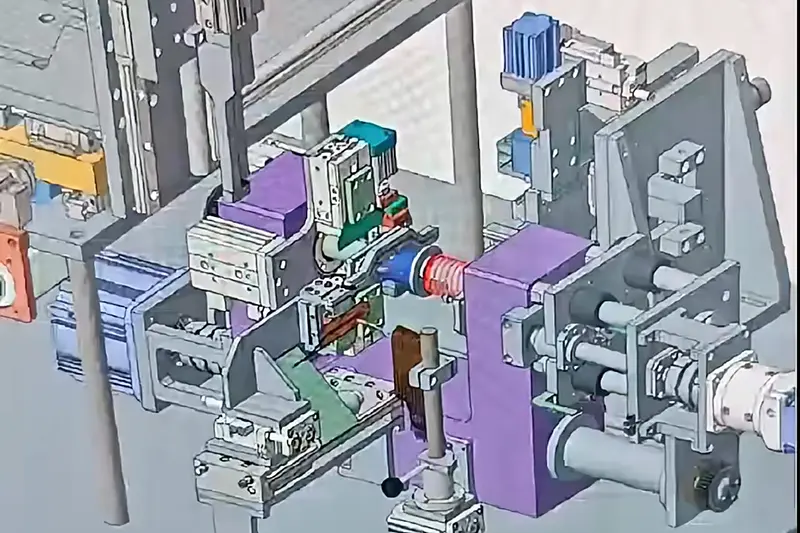
Wire Laying Flatness: Turns must be laid closely, uniformly, and without overlap. Even minor vibrations or cumulative errors in the wire-laying mechanism can cause the coil to bulge, affecting the final assembly thickness and heat dissipation. For the drive of the wire-laying mechanism, a direct-drive linear motor system with high response speed and high positioning accuracy is employed. This effectively eliminates the backlash and mechanical resonance associated with traditional lead screw drives, ensuring absolutely flat wire laying for large-diameter wires along complex trajectories.
Stress Relief and Shaping: Thick-gauge Litz wire experiences significant stress rebound when passing through bends. Tooling and molds must be designed with precise bend radii (R), and the winding process typically requires automated wire compression or hot-air shaping mechanisms to prevent coil deformation after demolding.
III. Insulation System and Scratch Protection
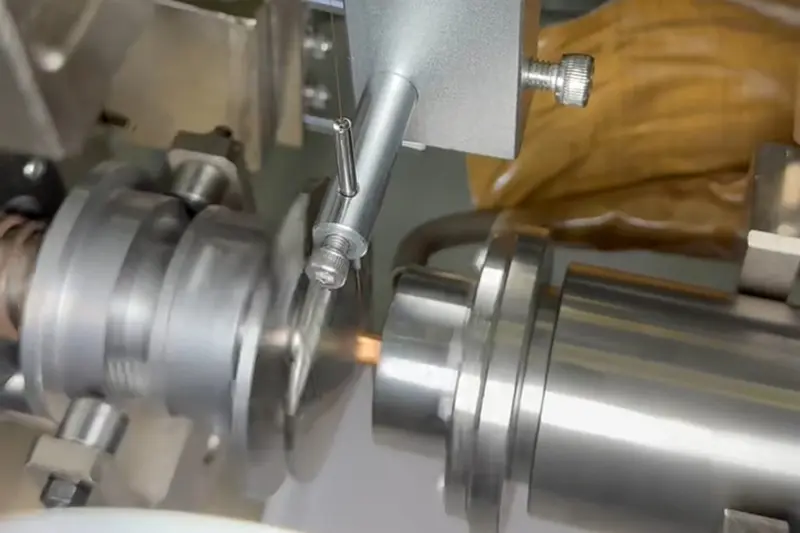
Guide Pins and Wire-Guiding Rollers: Automotive-grade high-voltage components have extremely stringent requirements for partial discharge (PD). The wire-guiding paths in winding equipment (wire nozzles, porcelain eyes, and wire-guiding rollers) must have extremely high surface finish (typically requiring mirror polishing) to prevent scratching the external insulation varnish or wire-wrapping layer during the winding process.
Interlayer Insulation Insertion: For multi-layer three-dimensional windings, interlayer insulation materials (such as Kapton tape) must be smoothly inserted during the automated winding process. The insulation layers must be tightly wrapped without wrinkles to prevent the formation of air gaps inside.
IV. Vibration-Resistant Treatment for Leads and Connectors
Stress Control at Start and End Points: Since vehicles operate in a continuous, wide-frequency vibration environment, the start and end points of the coil (where the leads are located) are the areas most prone to mechanical fatigue failure. During winding, a standard buffer curve must be incorporated at these points, and fixtures must be used for binding or to reserve space for potting.
Lead Length Consistency: Considering the complex enamel stripping (e.g., laser stripping) and ultrasonic terminal welding processes for the leads, the winding machine must precisely control the length and exit angle of the leads at both ends to ensure seamless integration with subsequent automated assembly lines.
About ZHPWT
Guangdong Zongheng Technology Co., Ltd. has dedicated 19 years to the R&D and intelligent manufacturing of precision winding machines for hollow coils, Alpha coils, voice coils, and similar components. Our equipment is widely utilized across various sectors, including smartphones, 3C electronics, new energy vehicles, home appliances, aerospace and defense, nuclear power, and marine engineering. For more details, Contact us: +86-186 2185 7689/Email:tech@zhpwt.com.
